
Digital Workers in healthcare
The Intelligent Clinic.
A Digital Worker is the steward that owns the journey. One continuing role across departments, available when your team needs status, a change, or help with an exception.
Watch the journey
The same Digital Worker.
From the plan to the follow-through.
Follow one cataract journey across the clinic. People make the decisions; the Digital Worker carries the context, coordinates the work, and keeps the team informed.
1 min 18 sec · Silent, with on-screen dialogue.
Illustrative design, not a recording of operational results.
Read the story
A Digital Worker is the steward that owns the journey.
The example follows a cataract patient from the consultation through recovery. The Surgical & Treatment Digital Worker remains a continuing organizational role. Its human supervisor is the surgical coordinator.
- The clinician sets the plan. The surgeon confirms the lens plan. The Digital Worker opens a journey record from that plan.
- The patient has a request. “Let me talk to my daughter.” With consent, the Digital Worker shares approved information and follows up on the agreed day. The reason for waiting remains visible.
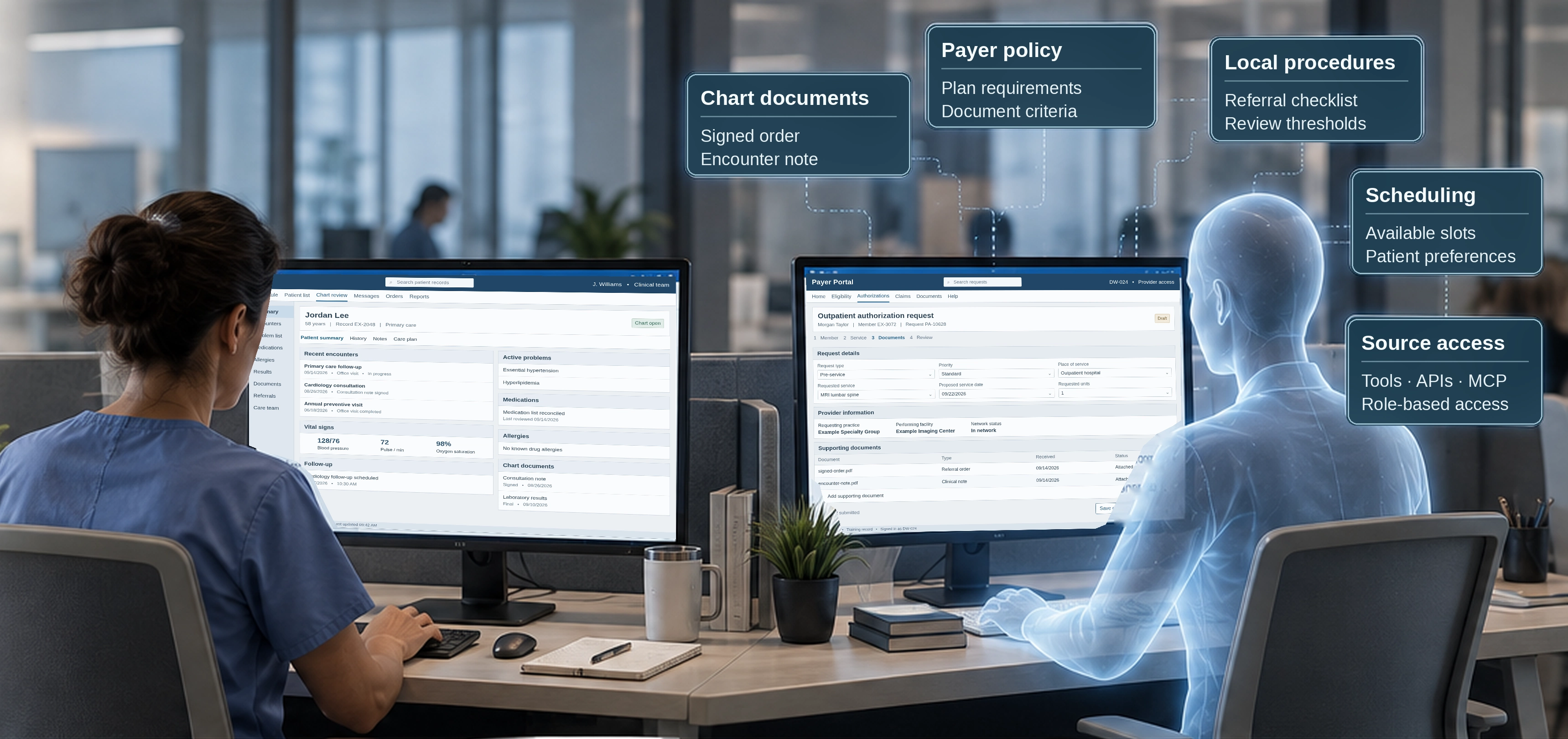
- One worker performs several functions. It coordinates scheduling, approved authorization work, preparation, and the lens order. These are parts of one case, not disconnected departmental handoffs.
- The team asks for status. “What still needs attention?” The same Digital Worker can say that authorization and the lens order are confirmed, while pre-op clearance remains with the nurse.
- A change has a scope and an end date. The coordinator requests family updates for this patient until surgery. Consent, the patient-specific scope, and the ending condition remain attached to the instruction. The instruction applies to this patient until the agreed ending condition.
- People provide the care. The Digital Worker coordinates family updates and arranges a briefed call. The surgeon makes the call.
- An exception reaches a person. A post-operative check-in needs review. The Digital Worker routes it to the nurse and tracks follow-through. It does not replace clinical judgment.
- The case closes; the worker continues. After recovery, ongoing follow-up passes to the Patient Steward and the claim to the Revenue Steward with the relevant record. The same Surgical & Treatment Digital Worker continues with the next surgical case.
Illustrative scenario with synthetic dialogue. It is not a recording of operational results. Human decisions, consent, and approved authority remain part of the work.
Designed around the work
Not one bot per department.
Each Digital Worker combines related functions around a continuing responsibility. It works across the teams involved, rather than copying one employee’s job.
Explore a Digital Worker’s responsibility
Each track is a continuing role, working across the teams it needs.
A Digital Worker as steward
Surgical & Treatment steward
Carries the pathway from indication to recovery: dates, authorization, preparation, supplies, family updates, follow-up, and case charges.
Works across
Human decisions
Clinicians decide indication and clearance. People conduct consent conversations and approve consequential exceptions.
Human supervisor: Surgical coordinator
DOpS keeps the record. Instructions, actions, and decisions stay connected. When responsibility moves to another Digital Worker, the transfer and the case context are explicit.
Start with one journey that needs better follow-through.
A conversation, a paid assessment, and a supported path into operation.